
Sensorfact replaced gut-feel purchasing with Odoo.
By 2023, Sensorfact had grown to 200 people and 1,600 customers in 40 countries. Procurement still ran on instinct. Five months later, Odoo had replaced it.

Sector
Energy. B2B climate-tech and Industrial IoT.
Footprint
3 home countries (Netherlands, Germany, Spain), serving customers in 40 countries.
Scale
1,600+ industrial customers, 200+ employees.
Dynapps partner
Since 2023.
Backing
Venture-backed. €13M growth round 2022, €25M growth round 2023.
Before Dynapps stepped in.
Sensorfact was founded in 2016 in Utrecht by Pieter Broekema, a former energy consultant who had watched industrial companies struggle to put a real number on their own energy consumption. The product is deliberately low-cost: smart IoT sensors that monitor energy use and surface machine-maintenance signals, backed by tailored advisory work for production businesses. By the time Dynapps came into the picture in mid-2023, Sensorfact had grown past 200 people across the Netherlands, Germany and Spain, was serving over 1,600 industrial customers in 40 countries, and had just closed a €13M growth round. Hans Beuker, COO, sponsored the engagement. The systems holding the company together were starting to creak.
The challenge
Where the cracks showed.
Stock visibility had eroded as Sensorfact scaled, and purchasing decisions were running on instinct rather than data. For a 200-person company shipping sensors to 1,600 industrial customers in 40 countries, that was not sustainable. Underneath it sat two structural problems.
Inventory tracked offline, across fragmented tools
Stock lived across a scatter of offline tools rather than one system. As the company scaled, the picture of what was actually on hand and what was on order got harder to trust.
No centralised product masterdata
There was no single product masterdata structure to lean on. Without it, every downstream process, purchasing, inventory, sales, worked from its own version of the catalogue.
Growth outran the spreadsheet.
€13M closed in 2022, €25M followed in 2023. The instinct-based purchasing was no longer a side issue. It was the system question that would decide whether operations could keep up with sales.
Sensorfact came directly to Odoo and partnered with Dynapps for the implementation. No competing ERPs were weighed in the qualification calls. The choice was not “which ERP” but “an ERP or not.”
How the rollout really happened
How Sensorfact went live on Odoo in five months.
2023
Dynapps partnership begins.
June 2023
Analysis phase begins.
July 2023
Implementation starts.
September 2023
Odoo live across purchase, inventory, accounting and sales.
End 2023
€25M growth round closes.
What Sensorfact runs on Odoo: purchase, inventory, accounting and sales.
Four Odoo modules went live in five months: purchase, inventory, accounting and sales. The intent was narrow on purpose: put the spine of the business onto one system, give the operations team visibility on what was in stock and what was on order, and move the purchasing decision from a feel exercise to a data one.
Engagement shape: five months from first contact to go-live in September 2023. On the Dynapps side, Satish Sewnarain led the engagement in a hybrid role, business consultant and project manager. On the Sensorfact side, Hans Beuker, COO, was the project sponsor. (Total Dynapps headcount and the Sensorfact-side key-user team are not in the source.)
Modules: purchase, inventory, accounting, sales.
The discipline throughout.
Scale-up implementation: start basic with discovery, then move directly into implementation rather than over-engineering scope upfront. The cadence borrows from the way scale-ups themselves operate, choose the minimum viable shape, get it live, refine afterwards. It is the principle that defined this engagement.
Going live while still learning the system.
The project moved very fast. The five-month timeline asked a lot of the key users at Sensorfact, who had to keep running the business while learning Odoo at the same speed Dynapps was configuring it. The team went live while still learning the system.
That trade-off is workable, but it carries a system-hygiene cost. When a team configures, tests and adopts a new ERP all in the same months, the cleanliness of the data, the discipline of the workflows and the maturity of the standard operating procedures all take a hit that has to be paid down afterwards. Sensorfact got the go-live; the work of cleaning up behind it was part of the deal.
The scale-up implementation approach, now standard for fast-growing customers.
The Sensorfact engagement crystallised a pattern Dynapps now applies to other fast-growing scale-ups: a deliberately compressed implementation approach. Start basic. Lead with discovery. Move directly into implementation rather than over-engineering scope upfront. The principle borrows from the way scale-ups themselves operate, choosing the minimum viable shape, getting it live, refining afterwards. It is now part of how Dynapps approaches engagements where the customer's pace of growth will outrun any traditional ERP timeline.
The numbers
By September 2023, the spine of the business ran on Odoo.
Five months after first contact, the spine of the business sat on one system. Purchase, inventory, accounting and sales went live together in September 2023, moving the operations team from offline inventory across fragmented tools to one source, and the purchasing decision from instinct to data.
5
months from first contact to go-live.
4
modules live at go-live: purchase, inventory, accounting, sales.
From ‘what do I think we need?’ to ‘what does the data say?’
The shift was not a module list. It was a change in the default question. Before Odoo, the buyer’s question was ‘what do I think we need this week?’ After Odoo, the question is ‘what does the data say we need this week?’ For a 200-person climate scale-up adding customers across 40 countries, that shift is what lets the operations team keep up with the commercial team. The instinct-based version of Sensorfact had a ceiling. The data-based version does not, or at least not the same one.
If this sounds familiar, let’s talk.
Wherever your business is heading and wherever it's getting stuck, an expert who has run this kind of work is the right person to start with, before you commit to a direction or a platform.
Go deeper
Read further.
Implement Odoo
From blueprint to go-live, built around how your industry actually operates.
Scaling for the next phase of growth
The business is ready to grow. The systems are not. A PE-backed trajectory, new markets, acquisitions ahead, and administrative overhead that drags on the very growth it should be enabling.
Energy & utilities
Installers, operators, producers, cooperatives. Each on Odoo, shaped to fit.
More stories like this
- Food & beverage
Food & beverage
Cazes: Odoo at the counter, SAP for the group books
Cazes moved its boutique and wine-fair sales onto Odoo Point of Sale, retired a clumsy SAP Fiori till, and left accounting, invoicing and alcohol duties on the Advini group's SAP S/4.
- Manufacturing
Manufacturing
How Nobi tracks every smart lamp from the Belgian assembly line to the care room.
A fast-growing health-tech manufacturer tried to stand up Odoo itself, hit a wall on serial-number traceability, and turned to Dynapps to clean up the setup and rebuild the flow, from component picking to a fully documented, serial-tracked finished product.
- Retail & wholesale
Retail & wholesale
Ergonomio replaced a twenty-year custom FileMaker webshop with one Odoo platform.
Moving from a bespoke FileMaker system to standard Odoo meant rebuilding every product record and letting go of a two-decade-old way of working.
- Energy & utilities

Energy & utilities
One Odoo platform for a multi-company energy consultancy: Tunérgia replaces Telegram, Excel and scattered tools
After sixteen years on paper, Excel and Telegram, Tunérgia put its multi-company energy consultancy onto one Odoo platform with Dynapps: leads, projects, signatures and surveys in one traceable place.
- Financial services

Financial services
How Régie Châtel runs every PPE assembly on one platform
A Swiss family agency runs more than 100 condominium administrations on a single custom platform built with Dynapps. It replaced a workflow of Word mail-merges and Excel trackers.
- Food & beverage
Food & beverage
One Odoo template across 14 Puratos production sites in four continents
Belgian family-owned ingredients manufacturer, 75 production units across 55 countries. Kept SAP at the largest sites; built one Odoo template for the smaller acquisitions.
- Financial services

Financial services
One Odoo backbone, from 100 to 36,000 leased bikes
Cyclis Bike Lease grew from a four-founder startup in Hasselt to 36,000+ leased bikes. Dynapps replaced the founders’ DIY setup with a single Odoo platform that scales with the business.
- Laboratories

Laboratories
Seven specialised labs on one integrated Odoo and LIMS platform
Seven specialised lab departments across Oman, 65,000 samples a year. The group replaced a legacy LIMS and added an ERP on one integrated Odoo and LIMS platform in four months.
- Retail & wholesale

Retail & wholesale
One Odoo across sales, purchasing, accounting: four-month cutover
Swiss distributor of corporate clothing and promotional products, with 13 users on Odoo. One platform now covers sales, purchasing and accounting, ending a multi-year search.
- Retail & wholesale
Retail & wholesale
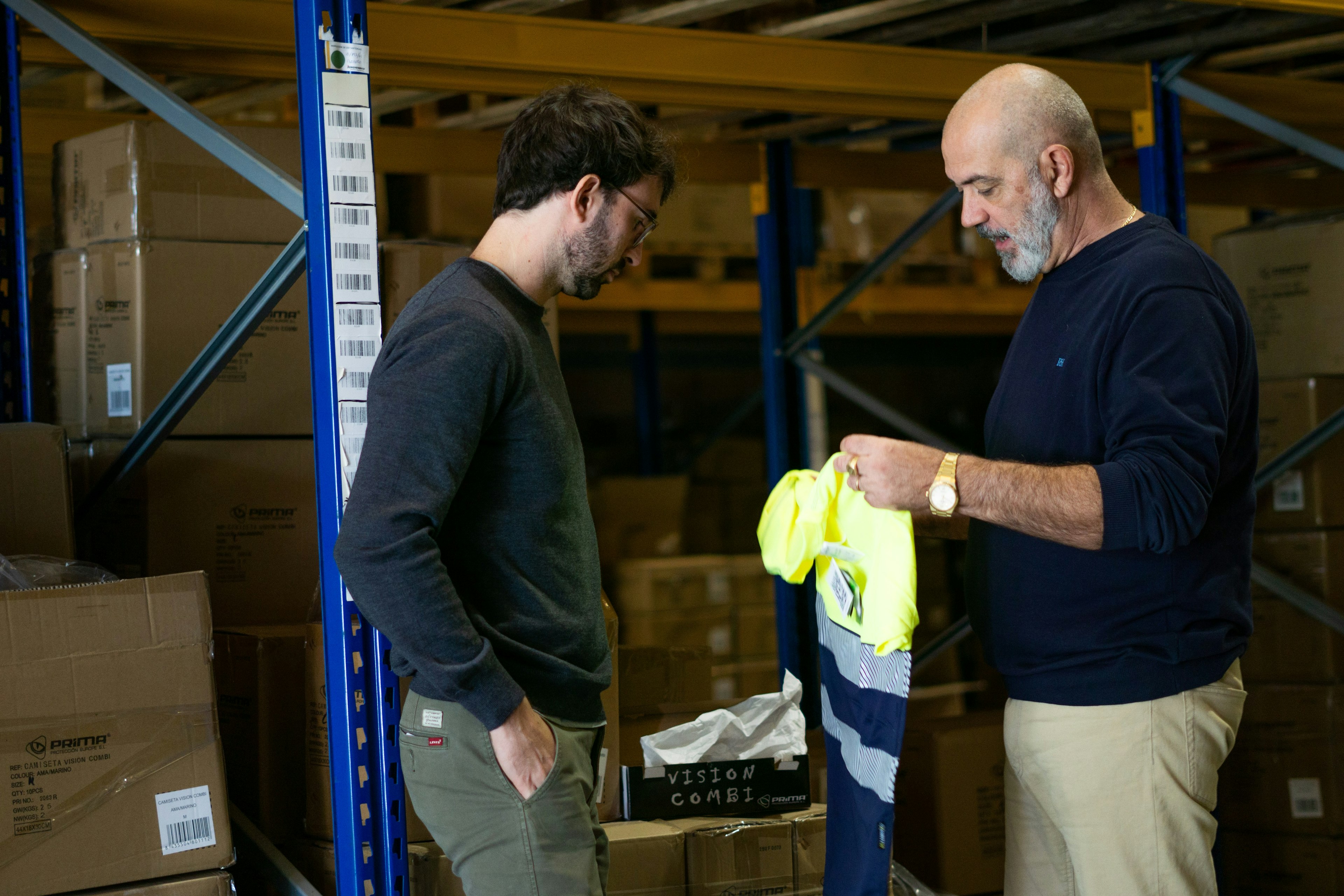
One Odoo backbone for a B2B safety distributor, with 95% of orders flowing through the web shop
A Spanish B2B distributor of high-visibility safety gear moved off a custom legacy system onto Odoo. A bulk-order grid on standard e-commerce now carries 95% of its orders.