
One platform for 73,000 cooperative members and the grid behind them.
How Ecopower replaced SAP with Odoo while keeping its citizen cooperative model intact, building a shareholder register and live electricity-contract integrations on the same backbone.
Sector
Energy, citizen energy cooperative.
Footprint
Belgium. Berchem (Antwerp) HQ.
Scale
73,000 cooperative members.
Dynapps partner
Since 2024.
Backing
Recognized cooperative company (member-owned)
Before Dynapps stepped in.
By autumn 2024, Ecopower had been running its back office on SAP for years. The cooperative had grown into something complex: a project developer for wind turbines, solar installations and heat networks; an electricity producer; a supplier; and a member-and-share register with 73,000 cooperants on the books. The system worked. But SAP was moving its mid-market customers onto a cloud strategy, and the consequences for Ecopower were material enough to force a decision: follow SAP into the cloud, or use the moment to re-evaluate the whole ERP question. Dirk, ICT lead and project manager at Ecopower, framed it that way from the start. The choice approaching was not about software. It was about which platform, and which partner, fit the cooperative for the next ten years.
The challenge
Where the cracks showed.
The 360° view that wasn’t
Ecopower’s whole proposition rests on the same person being three things at once: a member, a shareholder and an electricity customer. In SAP, the data lived split across systems that did not talk fluently. When a member called the helpdesk, the colleague on the line could find the answer, but not all of it in one place.
The pellet factory that no longer existed
When SAP was originally chosen, Ecopower still ran a pellet production plant with stock and manufacturing inside the ERP. By 2024 that was gone. A meaningful share of what SAP was configured to do had become overhead for processes the cooperative no longer ran.
The contract handoff between platforms
Electricity supply contracts and invoicing sit in a separate specialist system. Every supply event, a new connection, an address change, a billing-cycle close, was a data exchange between platforms, and the seams showed every time.
Why Ecopower used SAP’s cloud shift to move to Odoo.
The trigger was not a failure. It was SAP's own decision. Around 2023 to 2024, SAP's cloud-ERP track for mid-market customers like Ecopower came with material consequences for licensing, customisation and day-to-day behaviour. Ecopower used the moment to ask two questions Dirk now recommends to anyone in the same position. Is our current ERP still the best fit? And is our current service provider still the right partner to take us forward? Ecopower is direct that the partner question weighed as heavily as the product. Dynapps' position as a leading Odoo partner in Europe, the local presence, the personal contact and the flexibility shown during pre-sales, that is what tipped it. Two paths stayed on the shortlist:
Stay on SAP, move to its cloud track
SAP had been sized for a business that still included pellet manufacturing. That part of the operation no longer existed, and the platform's centre of gravity sat further from where Ecopower's real complexity lived: the member-shareholder-customer overlap.
Move to Odoo with Dynapps
Odoo had been on the original shortlist five years earlier and had lost narrowly to SAP. The second time, two things had changed. Odoo had matured into a platform sized for an organisation like Ecopower, and the team valued having a Belgian partner with Belgian software for a Belgian cooperative.

How the rollout really happened
How Ecopower replaced SAP with Odoo, replace first then expand.
2019
Filemaker to SAP migration completed. Business processes shaped to an ERP platform for the first time.
Early 2024
SAP cloud strategy clarifies. Ecopower opens the re-evaluation.
End 2024
Kickoff with Dynapps. Scope frozen around current operations first.
2025
Member administration and AGM registrations run through Odoo, nine months before official go-live.
2026
Official go-live, with PEPPOL e-invoicing live on the same day.
What Ecopower runs on Odoo: a cooperative shareholder register and live contract integration.
Standard Odoo runs CRM and prospection (live before go-live, tracking solar-roof leads), sales, invoicing, accounting, project management and approval workflows that replaced email and Teams threads for invoice sign-off.
Two builds went beyond standard. The cooperative shareholder register was built in Odoo, since no standard module covers it, and one record now holds membership, shareholding and customer relationship for all 73,000 members. A real-time integration with the electricity-contract platform handles contract setup, change and billing, so data exchanges live instead of in nightly batches.
On the Ecopower side the setup was deliberately decentralised: a named product owner per department, each shaping the functionality for their own team. Ecopower is clear a fully centralised approach would have moved more slowly through the change.
Modules: CRM & prospection, sales, invoicing, accounting, project, approval workflows, custom cooperative shareholder register, real-time electricity-contract integration, PEPPOL e-invoicing.
The discipline throughout.
Standard Odoo first, customisation only where the cooperative shape of the business made it necessary. Dirk set the principle at kickoff: replace what is currently in use first, layer new ambitions on after. The two custom pieces, the shareholder register and the live contract integration, earned their place against that rule; everything else went in as standard Odoo.
Two deadlines that could not slip, and complexity both sides underestimated.
The complexity was jointly underestimated. Ecopower and Dynapps did the analysis together at the start, but several processes needed more design and development than the original scope reflected, which added cost during the project.
Two frictions carried most of the weight. First, the integration: the electricity-contract platform had its own release rhythm, and aligning it with Odoo's was harder than planned. Coordinating several development parties on one go-live date is not the same as building inside one team. Second, the PEPPOL deadline fell on the same 1 January 2026 date as go-live, forcing a parallel critical path that could not slip on its own.
What kept it from sprawling, Dirk is clear, was transparency on scope, timing and cost whenever adjustments were needed. No surprises at the end. The cost moved. The relationship did not.

Odoo gives you a standard working platform. A partner like Dynapps makes sure it is tuned to the details of how your business actually runs.
Dirk Hermans
ICT lead and project manager at EcopowerTwo patterns we now carry into the next engagement.
Two patterns from the Ecopower engagement are worth carrying forward. Each of Ecopower's 73,000 members is a member, shareholder and customer at once, and no standard Odoo module covers that overlap. Building the shareholder register inside Odoo, alongside the customer record, produced a working reference for the same shape of problem in cooperatives, mutuals and member-driven utilities. The module is not productised; the approach exists and is documented.
PEPPOL on 1 January 2026 was not a Dynapps deliverable. It was a regulatory date the team had to land alongside its own cutover. Two parallel critical paths to the same go-live, with weekly trade-off conversations on scope, timing and cost, kept both deadlines intact.
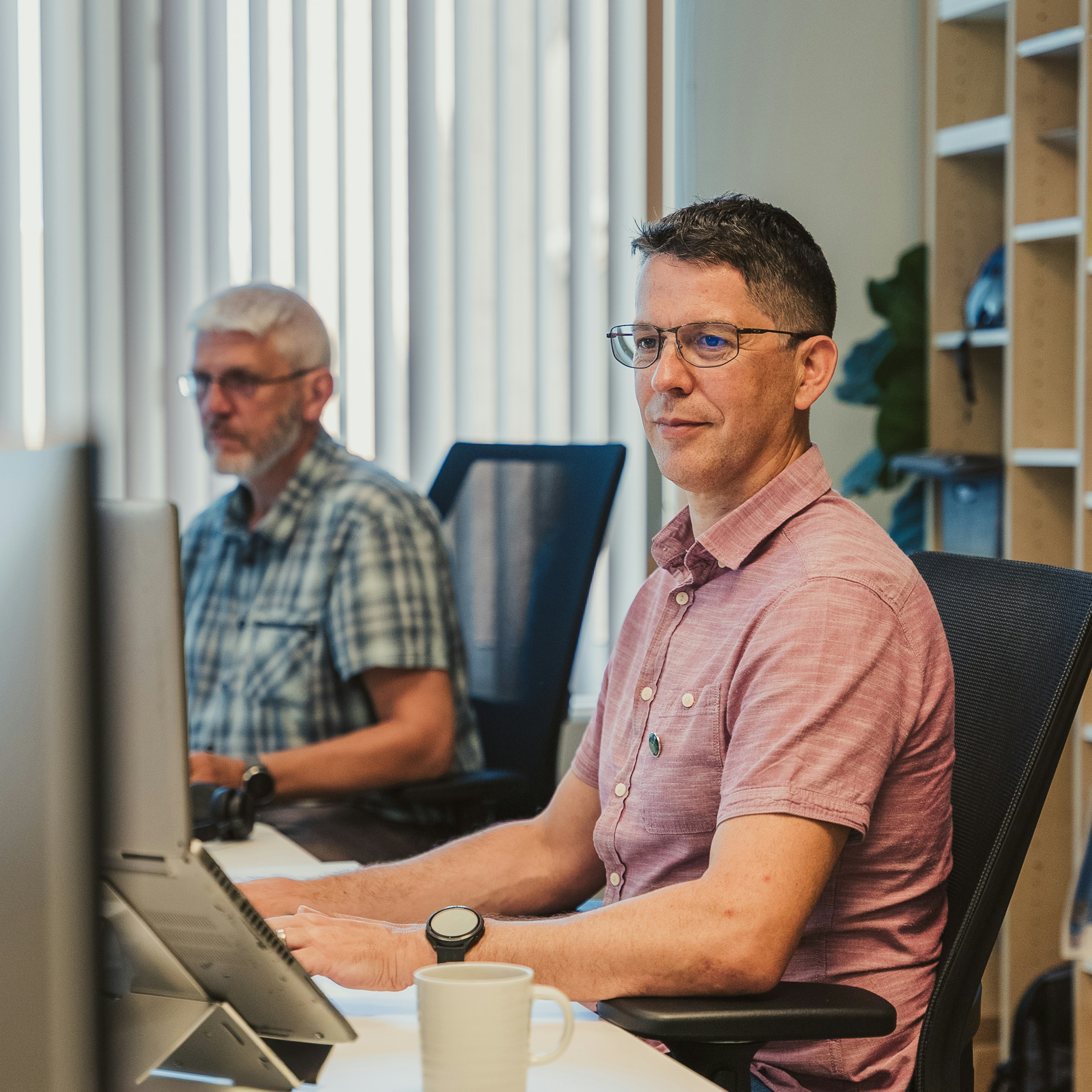
From ‘what extra system do we need?’ to ‘can this run in Odoo?’.
Before, when Ecopower added a new activity, a new generation site, a new community-energy product, a new way of letting members participate, the first internal question was 'what extra system do we need?' Now the first question is 'can this run in Odoo?' The cooperative is asking it about time tracking, document signing and whatever the next thing turns out to be. That shift, from assembling around the platform to building on it, is what the engagement was designed to make possible.
If this sounds familiar, let’s talk.
Wherever your business is heading and wherever it's getting stuck, an expert who has run this kind of work is the right person to start with, before you commit to a direction or a platform.
Go deeper
Read further.
Implement Odoo
From blueprint to go-live, built around how your industry actually operates.
Replacing a legacy ERP
The ERP that built the business now holds it back. Ten or twenty years of SAP Business One, Exact, Navision, Sage, or a custom build sits at the centre of operations, wrapped in integrations and spreadsheets only a few people understand.
Energy & utilities
Installers, operators, producers, cooperatives. Each on Odoo, shaped to fit.
More stories like this
- Food & beverage
Food & beverage
Cazes: Odoo at the counter, SAP for the group books
Cazes moved its boutique and wine-fair sales onto Odoo Point of Sale, retired a clumsy SAP Fiori till, and left accounting, invoicing and alcohol duties on the Advini group's SAP S/4.
- Manufacturing
Manufacturing
How Nobi tracks every smart lamp from the Belgian assembly line to the care room.
A fast-growing health-tech manufacturer tried to stand up Odoo itself, hit a wall on serial-number traceability, and turned to Dynapps to clean up the setup and rebuild the flow, from component picking to a fully documented, serial-tracked finished product.
- Retail & wholesale
Retail & wholesale
Ergonomio replaced a twenty-year custom FileMaker webshop with one Odoo platform.
Moving from a bespoke FileMaker system to standard Odoo meant rebuilding every product record and letting go of a two-decade-old way of working.
- Energy & utilities

Energy & utilities
One Odoo platform for a multi-company energy consultancy: Tunérgia replaces Telegram, Excel and scattered tools
After sixteen years on paper, Excel and Telegram, Tunérgia put its multi-company energy consultancy onto one Odoo platform with Dynapps: leads, projects, signatures and surveys in one traceable place.
- Financial services

Financial services
How Régie Châtel runs every PPE assembly on one platform
A Swiss family agency runs more than 100 condominium administrations on a single custom platform built with Dynapps. It replaced a workflow of Word mail-merges and Excel trackers.
- Food & beverage
Food & beverage
One Odoo template across 14 Puratos production sites in four continents
Belgian family-owned ingredients manufacturer, 75 production units across 55 countries. Kept SAP at the largest sites; built one Odoo template for the smaller acquisitions.
- Financial services

Financial services
One Odoo backbone, from 100 to 36,000 leased bikes
Cyclis Bike Lease grew from a four-founder startup in Hasselt to 36,000+ leased bikes. Dynapps replaced the founders’ DIY setup with a single Odoo platform that scales with the business.
- Laboratories

Laboratories
Seven specialised labs on one integrated Odoo and LIMS platform
Seven specialised lab departments across Oman, 65,000 samples a year. The group replaced a legacy LIMS and added an ERP on one integrated Odoo and LIMS platform in four months.
- Energy & utilities
Energy & utilities
Sensorfact replaced gut-feel purchasing with Odoo
Dutch climate-tech scale-up, 200+ people serving 1,600 industrial customers in 40 countries. Odoo replaced gut-feel purchasing with one system for purchase, inventory, accounting and sales in five months.
- Retail & wholesale

Retail & wholesale
One Odoo across sales, purchasing, accounting: four-month cutover
Swiss distributor of corporate clothing and promotional products, with 13 users on Odoo. One platform now covers sales, purchasing and accounting, ending a multi-year search.